Sunday, August 15, 2010

Chateau Oiseau Vineyard Update


It has been a long, hot summer! The vines have been doing well, but it has been dry, so watering has been important. When we went away on vacation for a week, it was really dry and one of the new Marquette vines croaked. That was a bummer. But the rest of the new vines planted this spring in the still-unnamed vineyard site, are doing pretty well. Most are up to the wire on the trellis, and a couple are even spreading out into a T shape.

The vines in the side yard (Clos Oiseau) are all spreading out on the trellis wire. Today I removed the grow tubes from them so the trunks will harden off. I am hopeful that next year I will have some grapes from these vines.

The Reliance vines down on the driveway (Cotes du Oiseau) are doing the best of all the vines in the yard. They are growing like weeds and will need some pretty vigorous pruning this winter. I am quite certain that I'll have grapes from those next summer--for munching, not wine.

-Jacques

A morning at Coastal Vineyards!


Yesterday I headed down to South Dartmouth, MA for a meeting with Dave Neilson, the winemaker and owner of Coastal Vineyards. I wanted to meet Dave because he is one of the first people to grow Marquette grapes in large quantity here in Massachusetts. If you are following this blog, you know that Marquette is a rather new variety of cold-hardy hybrid grape developed for red winemaking in cool climates. Unlike previous hybrids, Marquette is supposed to be one of the only cold hardy varieties that doesn't produce wine with the "foxy" taste for which labrusca-based wines are known.

I showed up at Coastal Vineyards around 10 AM and Dave met me in the driveway. We walked down into his vineyard, thriving with a dozen varieties of grapes including Merlot, Sauvignon Blanc, Chardonnay and even Pinot Noir. He has planted 2 rows of Marquette consisting of about 200 vines. I couldn't believe how well his Marquette has grown in only 2 years. It easily looks like it is a full year older than mine, when in fact it is the same age. Dave said it well when he described his Marquette as "growing like weeds."

Dave is a believer in vertical shoot positioning, and his Marquette seems to be really liking his location and his training system. He even has some Marquette grapes on the vines, which is not bad for vines in their second year! (See picture of me holding a bunch of them!)

After some tips on growing Marquette, we headed up to the winery to taste some of last year's whites and the '08 Merlot. I am not a fan of the syrupy Merlot from California but Coastal Vineyards does a lighter Merlot--more like a pinot noir. This is simply because it doesn't ripen as well in Massachusetts, so it's a lighter wine. They make a blush from the pinot noir. This is the reason he is experimenting with Marquette--it's a variety that ought to ripen exceptionally well in Massachusetts and make a full-bodied red wine. Of course, so far there are not enough grapes to make a batch of wine, but I expect Dave will have enough grapes in the fall of 2011 to make his first cuvée of Marquette. I can't wait to taste it!

Thanks Dave for the great advice, and taking time out of your day for me! And for those of you who want to try a really fantastic white that is estate grown right here in Massachusetts, I really recommend checking out the Coastal Vineyards Seaside White which is a blend of estate-grown Sauvignon Blanc and Gewürztraminer. Delicious! And for red, of course that Merlot!

-Jacques

Thursday, June 24, 2010

The Vineyard is flourishing with the coming of summer!


The 2010 Chateau Oiseau Chilean Malbec and Pinot Noir cuvées have been racked following completion of fermentation and have been inoculated with MLF bacteria to start the malolactic fermentation. Not much to show--and kind of boring, actually.

But in the vineyard, things are coming along well! The one year old vines in Clos Oiseau and Cotes du Oiseau are up to the trellis wire now (first couple pictures)! And the 3 week (!) old vines in grow tubes in the front yard (as yet unnamed vineyard) are rapidly climbing the grow tubes. Two have actually reached the top already. GROW TUBES RULE!!!

The wild labrusca vines in the back yard are taking over not only the simple trellis I built, but the entire woods behind it. Unfortunately, while they flowered this spring, there is not a sign of a grape. I have seen this variety of wild grape all over town now that I have an eye for it, and I have yet to see a single grape. This stuff might think it's grapes, but it's pretty useless if it doesn't actually make any. I might have to pull it out and plant something more useful in the spring. I'm toying with the idea of planting a few Cabernet Franc vines, which are said to perform fairly well in this part of Massachusetts.

-Jacques


Sunday, May 30, 2010

The 2010 Malbec is pressed!


Well, this evening the Malbec was down to 2.5 Brix so it was time to press, after a 10 day fermentation at 80 degrees. My daughter helped me out and, as usual, we had to press by hand. We start by disinfecting our hands with oxyclean and disinfecting the carboys, jugs, etc. We can't use sulfite to disinfect at this point as it would be toxic to the malolactic bacteria to be introduced later. So we use oxyclean, which works well using oxygen to kill microbes. Next, we go scoop at a time, dumping must into a mesh bag in a large funnel over a 6 gallon carboy. After a little over an hour pressing, we had 9 gallons (!) of wine from (7) 18 pound crates of Malbec grapes. We put airlocks in all the jugs and put them in the first floor bathroom shower to finish fermenting. Why the shower? Well, we never use our tiny first floor shower, and it's about 75 degrees all the time in there (we have central AC so we keep the house pretty much at 75 in the summer). The cellar is too cold to finish fermentation without heat, and the electric blanket is not consistent enough when wrapped around 2 carboys, 4 one gallon jugs, 3 half-gallon jugs, etc. So the Malbec has joined the Pinot Noir that was pressed two days ago in the shower, and it will sit for a few weeks to completely finish fermentation. They are all nicely bubbling though their airlocks now.

-Jacques

Saturday, May 29, 2010

The Vineyard is coming along....


Well, my new Marquette vines finally arrived...late. Very late. They should have been in a month ago. But at least I was able to get them in the ground immediately after the UPS truck departed. The kids helped. We had 10 vines to get in the ground. We soaked the roots of the dormant vines, and planted them all in a prepared space (with no name yet). I already have two trellises set up with another to be built. The next day I put the grow tubes on them and staked them. Hopefully with luck they will reach the wire of the trellis by the end of the summer. In the meantime, the other two "vineyards" are doing well.

Clos Oiseau, in the side yard has 6 Marquette vines that are all now above the grow tubes and reaching for the wire. Cotes du Oiseau on the hillside next to the driveway has 4 healthy Reliance vines growing up out of the grow tubes. It looks like only one of the cuttings survived, but I do have one healthy cutting to transplant to my mother-in-law next spring!

As for the wine in the cellar, the Malbec measured 7.5 Brix this morning. I might be pressing it tomorrow. We'll see.

Captions

1. The new Marquette vines in the as-yet-unnamed vineyard.
2. The healthy Reliance vines of Cotes du Oiseau. They are one year old.
3 & 4: The Marquette vines in the Clos Oiseau vineyard. They are one year old.

Friday, May 28, 2010

Pinot Noir is pressed...

Last night the Pinot Noir was down to 3.5 brix, so I scheduled this morning to press the grapes. Not owning a press, I did it the same way I did the last batch--by hand with a press bag and a funnel. (See previous blog post for sample pics. I couldn't shoot pics by myself this morning.) I ended up with 8.5 gallons of wine. There were quite a few whole berries in there. Once you press them, you get a fair amount of sugar back into the wine, so the fermentation picks up again in the carboy. So right now I have a 6 gallon carboy, (2) one gallon jugs and (1) 1/2 gallon jug, all with airlocks in the necks. They are still fermenting. I will let them sit and ferment to total dryness over the next 3 weeks. The Malbec was down to 10 brix last night (remember, it was chaptalized) so I expect it will be ready to press in 2 days.

In other developments, the 10 additional Marquette vines showed up yesterday, so the kids helped me plant them yesterday. Today I put them all in grow tubes. Tomorrow I'll post some pics of the developing vineyard!

-Jacques

Thursday, May 27, 2010

Fermentation Continues on the Chilean grapes!


Hey Everyone,
Time for an update on the 2010 Chilean grapes. Fermentation has been going for 5 days on the Pinot Noir and the Malbec. Two nights ago I chaptalized (added sugar to) the Malbec as the must measured only 22 Brix, which is a bit low. Some calculations suggested that about 2 pounds of sugar would be about right. I used unrefined (brown colored) sugar which is a little more natural. My first inclination was to just ferment them at 22 Brix, but the alcohol would be a little low. The problem there is that Malbec is naturally a bit tannic, as it is a big, bold, thick skinned grape like Cabernet Sauvignon, so without the alcohol to counter the tannin, the wine would taste overly tannic and have a strongly astringent mouthfeel. Benoit Germain suggested I chaptalize. When a winemaker from Burgundy tells you what to do, you just do it. So I did it. Once I added the sugar, Brix measured 3.5 points higher. Benoit suggested that I wait until the fermentation was well underway before adding the sugar. So I added the sugar at 15.5 Brix with a solid 80 degree fermentation going and it brought the must up to 19 Brix (3.5 increase) which extrapolates out to making the must as if it started at 22+3.5=25.5 Brix. That should be about right.

The Pinot Noir on the other hand was perfect at 24.5 Brix to start with. I did absolutely nothing to the pinot noir.

So after 5 days of fermentation, last night the Pinot noir was down to 7.5 Brix and the Malbec (post chaptalization) was down to 15 Brix. They are dropping around 4 Brix a day.

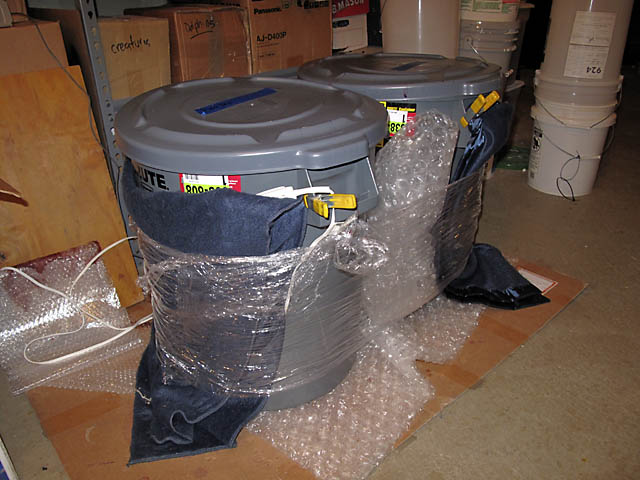
One of my QC improvements since the last batch is a temperature controller for the heat on the fermenters. You may recall that my extremely high-tech heating system for the fermenters is just a cheap electric blanket wrapped around them. The problem is that you really can't find a setting on the blanket that keeps the must at the right temperature because the fermentation process is exothermic but not constant. It throws off heat, but the amount of heat it throws off is a factor of how strong the fermentation is. At the beginning, the fermentation is not going strong yet, so you need to add heat to the fermenters to keep the must warm to get it started. Once it gets going, the fermentation heat production goes up. At that point, the electric blanket can be shut off. As the fermentation loses strength, the external heat has to be applied again, increasingly stronger as time goes on, to hold the must temperature up so the fermentation won't stall. So the heat put out by the fermentation over time looks like a bell curve, and the heat that needs to be applied to the fermenters looks like the inverse of that curve (an upside down bell curve.) The temperature controller has a probe you stick in the must and a temperature set point. When the temperature of the must hits the set point, the controller shuts off the electric blanket. When the temperature drops a couple degrees down (also settable) it kicks the blanket back on. It works great! No longer do I have great swings of temperature. The biggest problem I had with my last batch was the heat getting too high and encouraging the growth of bacteria. I have my temperature set at 83 degrees with a 3 degree delta so my temperature stays between 80-83 all the time. Perfect.

Of course, if I were doing this in my first floor with a nice even 75 degree room temperature, I probably wouldn't need any of this. But in the cellar (temperature currently 62 degrees) it's just too cold to conduct a fermentation reliably. And a cool fermentation like that would not extract much fruit.

I enjoy my three times a day punching routine as it gives me a chance to smell the sweet smell of fermentation and have a look at how things are coming along. The cap rises way up between punches. Punching gets the cap back under the juice so the top berries don't dry out or grow mold. It helps extract more flavor and tannin from the skins. However, there is such as thing as punching too much--extracting too much tannin. So I punch three times a day, approximately 9 AM, 3 PM and again before bed.

Attached are a few pics.

1. The fermenters wrapped in an electric blanket and some plastic to hold it in place.
2. The readout on the temperature controller.
3. Punching the must--when the punch tool goes through the cap, foam comes up from CO2 underneath.
4. After punching the whole cap, all the CO2 is released from under the cap.

Too bad I can't post the wonderful aroma!

Jacques