Saturday, May 21, 2011


Merlot? Merlot, you ask? Well, I'm not a huge Merlot fan to be honest. I ordered Chilean pinot noir. But my local winemaking place called and said the Chilean Pinot noir looked really bad this year and M&M wine grape in CT didn't send it to MA because it was so bad and they knew my local retailer would refuse it. So they called and offered me Merlot or Malbec. The last batch of Malbec from Chile had some pretty bad numbers to be honest, so I decided to try Merlot, which is a lot easier to ripen. It was a tough year for Chile so I'm looking for something that will actually make decent wine.

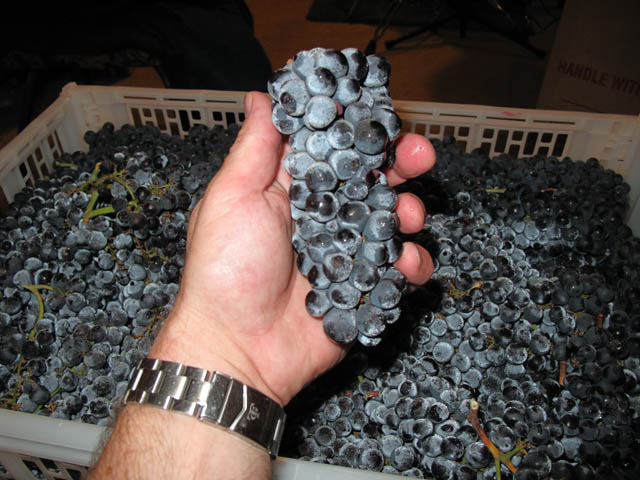
I took delivery of (8) 18 pound lugs of Merlot. They didn't look terrible, but not great either. A few fuzzy grapes with mildew and a few rotted ones here and there, but not as bad as the Malbec as I was told by my local winemaking buddy Steve. I sorted them carefully and also did something I have never tried before: rinsing. In the past I have had issues with Hydrogen Sulfide in my Chilean wines. I got a tip to rinse the excess sulfur off the grapes that is added as a preservative for shipping. We'll see if it happens.

As I was rinsing and sorting, I pulled out my trust refractometer to measure the brix of a few sample grapes from each lug. It was interesting that it was very consistent within each lug. For example, I tested about 5 grapes in one lug from different bunches and got 25 brix. In the next lug I got very consistent 27 brix. In the next, 24. The rinsing probably adds a tad of water to the mix, slightly diluting the must, but with grapes ranging from 24-27, I'll be ok.

Of course, once again I enlisted the kids to be my destemmers (slave labor true, but they enjoy it). I let the must warm to 60 degrees in the cellar overnight before adding the yeast (RC212 with Go Ferm starter) and now we have a nice ferment going. The numbers were about perfect on the Merlot though. Once I had enough juice in the morning to get a hydrometer reading and a sample for the pH meter, I got a Brix of 24.5 and pH of 3.55. Can't really complain about that. Once it hit 65 on it's own I turned on the heat and set it to 75. The cellar smells wonderful and I'm punching the cap three times a day.

-Jacques

Wednesday, May 11, 2011

Spring is here finally!


The past two weeks have seen the re-awakening of the vineyard! On April 28 (see picture) the Marquette vines were just starting to break buds. Today, 2 weeks later, we have lots of leaves and even a few inches of growth on many shoots! I doubt I will get grapes this year. The vines are still too small. My Clos Oiseau vineyard in the side yard is entering the third year, but since the first year I didn't use grow tubes, they are only modestly larger than the 2 year old vines on the other side of the yard that did use grow tubes. For all practical purposes, the Marquette is all 2 years old.

I have ordered a few more Marquette vines to replace a couple that did make it, plus some for another small site out back. (Yes, I'm squeezing grapes everywhere there is light!)

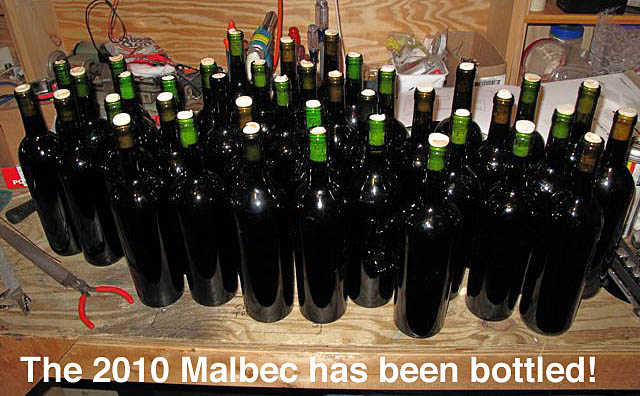
Last night, with the knowledge that the Chilean grapes are coming in the next week or two, I decided to bottle the 2010 Chilean Malbec to clear out some carboys. So now I have 40 bottles of truly not-that-great Malbec awaiting labels. I considered not even bottling it, but I needed the practice with the corker. Also I have a ton of bottles, and corks that will go bad if I don't use them. So what the heck. I'll give the stuff a couple years and see if it improves. If nothing else, it makes a good picture.

Working on labels now...

-Jacques

Saturday, April 9, 2011

Finally it feels like spring!


It has been pretty cold this spring in Massachusetts. We even had a snowstorm on April Fools day, just to throw us for a loop. But today it was beautiful--sunny and 65 degrees. It was time for a little yard work. I installed my new drip irrigation system on my vines. I bought the kit from drip depot and it wasn't even very expensive. For about $150 I have a system that will automatically water the vines precisely every day to my programming specs. Each vine has a 1 gal/hour dripper on it. I will not be watering the weeds with soaker hoses. But most importantly, hopefully the vines will make better progress than they did last summer when my watering system was by hand with a hose. We went away on vacation for a week during a hot spell and one of the vines croaked. (Replacement on the way).

After my new irrigation system was in, I put some composted cow manure around the bases of the vines. Not only will this allow good nutrients to seep into the ground, but I find that weeds do not readily grow up through the manure and it keeps the area clear most of the summer.

Now we just need some prolonged warm weather so these babies can start budding--and no late freezes!

A few of my vines grew enough last summer that they needed pruning, so I stuck the pruned shoots into a pot with dirt in the house in a sunny window and they are already sprouting leaves. This could be the start of my nursery. The problem is I don't have any more good places to plant any more vines with enough light, so I may be starting another vineyard at my dad's house. He doesn't know about this plan yet though.

In the cellar, the 2010 spring Chilean Pinot Noir and Malbec is going to be bottled soon. It's really not that good at all. I almost considered pouring it all out--what's the point of bottling wine I don't really like? But I figured I need to practice the whole bottling thing, and who knows, in a few years maybe it will be more palatable. I'll never know if I don't bottle some of it.

The 2010 fall California Pinot Noir tastes good. It didn't finish MLF so I'm going to try to get it to finish with a nutrient addition and warming it to 72 degrees. This will probably be the first wine I have made that I actually might drink. It's all about learning.

I ordered my 2011 Chilean pinot noir grapes last month and they should be here around Mother's Day so I can start a new cuvée. I'm hoping that I have learned enough by now to make this batch really really good! Of course, the whole point is to become good enough at making wine that by the time I have my own grapes, I'll know what I'm doing. Looking at my sparse vineyard, I think it's going to be a while.

-Jacques

Wednesday, February 2, 2011

Winter at Chateau Oiseau!


While the 2010 cuvées are doing their thing in the cellar, winter has firmly descended upon Chateau Oiseau! We are experiencing one of the most snow-intensive winters in many years. We have had nearly 8 feet of snowfall so far (and it's only Feb 2). Right now we have 3-4 feet on the ground in our yard. Check out this shot of the vines of Cotes du Oiseau next to the driveway! Buried nearly to the top wire! Spring might come late with all the melting that needs to happen, but at least water won't be in short supply! Right now I'm counting the days until spring.

-Jacques

Monday, October 11, 2010

Update on the 2010 California Pinot Noir


Well, after a day of allowing the yeast to get going and the temperature up to 70 degrees naturally, I finally put the thermostat probe into the must and turned on the heater (an electric blanket) to bring the must to my desired fermentation temperature of 80 degrees. When the must was down to 15 Brix, I added K-Fermaid, a nutrient for yeast that I have never used before. It seemed to speed the fermentation at the end and the result was a day shorter fermentation than I'm used to. This morning I went down to check the brix expecting 3 and it was 1.5, down from 6 yesterday morning. Time to press! So I pressed, which releases additional sugar from the grapes and invigorates the yeast with some oxygen, so once it was in the carboys, fermentation picked up again, with a healthy bunch of bubbles on top. Now I will let the wine sit overnight. Tomorrow I will rack it off the gross lees (learned my lesson on that one with the last batch!) and allow it to ferment to dryness before MLF.

In other news, right now I'm sipping my first taste of Marquette (the variety of grape I am growing in my "vineyard") made by Lincoln Peak winery in Vermont. It's amazingly high in alcohol (13.8%) for a grape grown in a cold climate, and the pH is ~3.27, which is quite low. These grapes were ripe (25+ Brix) and acidic, actually a pretty good combination, although the wine tastes to me a little acidic and thin, like it didn't go through MLF. There is no detectible "foxy" taste common to labrusca-based wines. (Marquette is a hybrid between vinifera and labrusca species). It tastes a tad peppery, but honestly between the hotness of the alcohol and the acidity, it's hard to describe many flavors. I get some floral and some licorice on the nose. I hope I can do better with my Marquette, but on the other hand, this shows that a serious wine can be made with grapes grown in a cold climate.

-Jacques

Wednesday, October 6, 2010

The Fall 2010 Grapes are here!


Yesterday I got the call I was waiting for from Beer and Wine Hobby. My grapes were in! So I hopped in the car and drove over to pick them up. I ordered 3 cases (36 pounds each) of "select" northern California pinot noir a couple months ago. After loading the car, I drove home to get right to work. First, sanitizing the primary fermentor, then using my goofball technique of hand destemming and crushing the grapes. (One of these days, someone will market a small, cheap hand cranked crusher-destemmer for guys like me. I can't see buying a big electric unit that I will use a couple times a year for about 5 minutes and then have to store the thing the rest of the time.)

Next I dumped 100 mL of 5% meta solution on the grapes to kill bacteria and took some measurements. I used my refractometer to test the brix since there wasn't enough free juice in there to easily get a hydrometer in. Also, I'm a geek and I like the refractometer. I have been using it to measure the brix of table grapes, wild grapes...pretty much any grape I see...just for fun.

So these come it at:
24 Brix
pH 3.23
Temperature 50 degrees.

My friend Steve who got the same exact grapes on the same day as me came up with a pH of 3.4, so I'll calibrate my pH meter and check this again in a few days.

Since the sugar and acid levels looked good, I could start fermentation without having to mess with anything. But the must was too cold. One of the tips I got from Benoit Germain back in May is to start the fermentation cold so that the yeast gets going before the temperature is high enough for bacteria to take over. Doing it this way, once temperature of the fermentation starts coming up, the CO2 made by the yeast will help protect the must from bacteria. Benoit's advice was to introduce the yeast at 60 degrees and let it get going slowly over a few days, rather than try to warm the must prior to introducing yeast. This is just an invitation to bacterial infection.

So this morning, the must was up to 60 degrees (cellar is currently 64 degrees). I re-hydrated the yeast (RC212) in water with a teaspoon of sugar. Within an hour it was a foaming cup full of happy yeast cells. I dumped them on top of the must. (Never stir them in...they need oxygen to get going so you dump them on top and give them a day before stirring or punching).

By tomorrow I hope to have a nice bubbling cauldron of happy yeast!

-Jacques

Saturday, September 11, 2010

Racking time


This whole winemaking thing is a lot of work. I decided tonight that I wanted to taste, test and rack my two 2010 Chilean wines again. The pinot noir has been sitting with an oak "spiral" in it for 2 months to add a little oak without the use of a barrel. The Malbec has not had the oak added yet, but needs a few more rackings to remove the hydrogen sulfide odor that I inadvertently allowed to happen by letting the wine sit on the gross lees too long while I was in Australia in the spring.

So first I checked the Malbec pH (3.25) to make sure it was the same as the last time I measured it. Then I did a titration to check the SO2 (it was 50 PPM, a tad high for this low pH, but not terrible). Next I tasted the wine. The H2S smell is still there, although it's not that strong. The wine tastes really excellent though--once you aerate the H2S smell out with a few swirls. I decided to rack through some copper to try to reduce the Hydrogen sulfide. (Copper reacts with the sulfur and precipitates it out). If racking and a little metallic copper contact doesn't help the H2S situation, I will be forced to use the age old copper sulfate treatment to bind up the sulfur and settle it out as precipitate. If I can get a handle on this H2S issue, this is going to be a great wine. So anyway, I racked it and added the oak spiral to the Malbec.

Lesson learned: always rack the freshly-pressed wine off the gross lees the day after pressing! Don't go to Australia and let it finish fermenting on the gross lees unless you like a swampy smell!!!

Next I tested and tasted the pinot noir. Ironically, this wine tasted better at the last racking than the Malbec, but now it's not as good. My Malic acid test showed that neither of these wines completed MLF--which I knew because they just didn't do anything after adding the MLF bacteria. I finally gave up. But unlike the Malbec which has enough alcohol to offset the low pH, the pinot noir doesn't. The pinot has pH of 3.35 (a tad low) but it tastes quite acidic. It's a little late in the game to alter the pH chemically (and frankly, I'm against playing with the pH of wine artificially).

Both wines had considerable tartrate crystals in the bottom of the carboys. Maybe a cold stabilization to precipitate a little more? Have to think about that. Both wines have clarified beautifully and have another 7 months in bulk aging before it's time to bottle, so I have time to let them mellow and see what happens. It's still a little early to worry too much about it.

On another note, I put in my order for the fall California grapes. I considered doing two cuvées again, but I just don't have enough carboys and the place is getting full of them. So I decided to do one batch of Northern California pinot noir. The grapes are due in October, hopefully not interfering with a business trip to Bonaire at the end of Sept. I ordered 100 pounds of pinot noir.

So that's the update from here!

Jacques