Monday, December 29, 2014

Pruning time!

I know I have written previously about the pruning process in a fair amount of detail, so there isn't much to add here except that I have just completed all the pruning for this season and the vines are now ready to go for next season.  I am always amazed by the sheer volume of shoots produced by the vines and how many cuttings I have to burn every year.  I get plenty of use out of my burn barrel.  Now I'm anxiously awaiting spring, warm weather and the next vintage!  Every year I learn a few new things and get a little better at growing grapes and making wine.  It's exciting, humbling, and a constant source of both wonder and stress!  A vineyard is an absolutely astonishing amount of work and you are at odds with critters and weather for 3/4 of the year!  Fortunately, the winter is a time of low stress.  The vines are pruned and dormant.  They will be fine until I have to start worrying again--about things like frost after budbreak, rain during flowering, fruit set, birds, yellowjackets, nets, hail, rain, and harvest.  Oh well, it's all part of the adventure!

-Jacques

The burn barrel is consuming all the cuttings.

"Le Grand Oiseau" from the west end.  Pruning almost done.

A pruned vine ready for spring.

The oldest vines (from 2009) are getting thick!

Marquette is tricky...or at least mine is!

With harvest numbers around 23 brix and a pH of 3.3 on my Marquette, I was worried about the fruit not being ripe enough.  Well, after fermentation and MLF with VP41, my post-ferment pH rose to an astonishing 3.8!  Unfortunately, I neglected to measure the pH between the alcoholic fermentation and the MLF.  So either a lot of potassium came out of the skins during primary fermentation or there's a ton of malic acid in the grapes that turned into lactic during MLF.  Either way, this is the second year that I have seen such a substantial rise in the pH during vinification with my Marquette.  (Never seen this with other varieties).  I ended up having to add some tartaric acid to allow the wine to be stabilized with a reasonable dose of meta.  I brought it down to 3.7 (any lower and the tartaric really impacts flavor).  Who would have thought that harvesting at a pH of 3.3 was too ripe?  I have asked my friend David Neilson, winemaker and owner of Coastal Vineyards about this issue and he has never seen this in his Marquette. Anyone got any ideas?

So right now I have 17 gallons of wine, my first decent batch of Marquette.  Half is in my barrel and the other half in glass.  I'll swap them out after 3 months in oak.  (My small barrel over-oaks a wine easily if you aren't careful).  So far, taste testing shows that my Marquette is pretty low on tannins, a lot like Pinot Noir.  This is definitely not a Cab or Zin-like wine.  It has good color, and a cherry-like aroma.  I'm concerned about the pH though, the taste is a little flabby and bland. Hoping it comes around a little in barrel.

-Jacques

Monday, September 22, 2014

2014 Marquette Harvest!

Every year that I have been growing grapes has brought something different.  In 2012, I had the summer hail from hell which destroyed much of my crop.  Later that summer, I lost most of what remained to evil grape sucking yellow jackets.  In 2013, I switched to insect netting (instead of plain bird netting) in an attempt to exclude both birds and yellow jackets.  But the nets, with finer weave, do not tangle the birds up as much.  As a result, they are not afraid of it.  They persistently attacked the nets until they got in at the ends, and devoured at least half the crop.  I got a crop, but it was only 80 pounds from 30 vines.  (Admittedly, many were immature vines.  I was expecting about 150 pounds).

This year there was no messing around!  I stapled the nets at the end of the rows right to the posts of the trellis.  Taking the nets off took a little longer but no birds got in.  No yellow jackets ate my grapes either.  :-)  Happy Jacques.

But all was not perfect this year!  There is always something.

This year started with a fairly mild winter, but spring was late.  In fact, my Marquette vines budded more than a week later than usual, and flowering was over a week later than usual.  Veraison was more than a week late too!  On top of that, it was a cool summer.  Last year I harvested in the first week of Sept and the grapes were over-ripe.  This year when I checked the brix at that same time of the month, they were barely 16 brix!  So much for global warming.

So I let them hang.  Unfortunately, I have one of those things called a job, and for my job I travel frequently which often means I'm not home on the ideal day to harvest.  Last week I was out on two back to back TV shoots and when I got home, I ran out to check the grapes.  I expected them to be hanging another week, but in fact two of my "blocks" of vines were probably about as good as they were going to get.  (The third block of just 5 vines, in a slightly less sunny spot, was running a week later than the other two blocks).  While some of the grapes were only showing on the refractometer as 20 brix, others were raisoning up, so they were over-ripe.  I hoped that by harvesting then, I would get decent numbers averaging between those two.  My goal in an ideal world is 24-25 brix and pH of 3.4.  (In my limited experience, there is a fair amount of malic acid in Marquette and many cold-hardy varieties.  As a result, pH rises quite a bit through MLF.  If you want to end up in the ideal pH of 3.6, you need to start around 3.4.  Maybe even lower.)

So I put the word out to my friends via facebook that I was harvesting that day with last minute notice.  A few people even showed up to help!  (Thanks Suzanne, Chris, Mia and Peter!) We pulled off the nets and started cutting the fruit off the vines.  I have to admit, after 6 years of relentless work tending the vines, it was really cool to finally have a good harvest, and a few friends here to join in the fun! From the two blocks we harvested, I got 200 pounds of fruit!  Hey, that's enough to warrant getting out the crusher/destemmer!  So we crushed it all, and it nicely filled a single large "Brute" fermenter.

I added the requisite dose of meta and a dash of enzymes (need to extract those tannins!) and waited 12 hours for the moment of truth:  a solid analysis of the brix and pH.  And the result? 23 brix at a pH of 3.3.  A couple more days to get the brix up to 24 and the pH up to 3.4 would have been perfect, but honestly, I'm not complaining.  These numbers aren't bad at all.  I decided to make absolutely no adjustments to anything.  It's close enough!

I am fermenting with plain old BDX.  I love that yeast--wonderful flavor.  I tried 71B last year for its malic acid-eating performance, but I just don't think it's a great yeast other than that.  I ordered some VP41 MLB which will take care of that malic acid just fine!

So 200 pounds should give me about 12 gallons, more than enough for my 8 gallon barrel.  The real question is, how do I handle the piddly 30 pounds or so that will come off the last block next week?

-Jacques

Pulling the nets and time for harvest!
My daughter joins the harvest!

My friend Suzanne Nobile poses by some of the harvest.

Elise turns the crank and the grapes get crushed!  Neighbor Peter Brayton looks on.


Sunday, September 21, 2014

What is Real Winemaking?

This simple question can be answered in many ways from a philosophical answer to a technical one.  But the issue I'm talking about is one that comes up all the time in home winemaker circles:  What constitutes making your own wine?  Is making wine from a kit really winemaking?  Do you have to grow your own grapes to be considered a real winemaker?  And of course the answers are all over the map.  Analogies are drawn between cooking and winemaking.  Comparisons are made between professional winemaking and amateurs.

The most common argument I like to make is a cooking analogy.  You should know that I make a mean Mac & Cheese!  My kids love it, they think it's the greatest food ever!  It's Kraft Mac & Cheese.  Anyone can make it.  It's a kit in a box.  You follow the directions and, in under ten minutes, you have a meal kids love.  Does this make me a good cook?  My kids prefer this Mac & Cheese to the homemade one that their grandmother makes.  If we entered our Mac & Cheeses in a competition and I won, would that be fair?  Would I really be an award-winning Mac & Cheese maker?  I personally have no problem with anyone who wants to make wine from a kit, but it's not true winemaking, just like making Kraft Mac & Cheese is not really cooking.  I personally do not feel that wines made from kits should be judged up against wines made from fruit in wine competitions.  They are different classes of winemaking.  I'm not saying that a kit can't be as good or better in many cases than a wine made from fresh grapes, or vice versa.  They are just different entities.

But when you make that argument, someone is bound to say..."Well...grandma didn't grow the wheat to make the pasta in her Mac & Cheese.  She bought the pasta at the store."  This starts the inevitable argument about what constitutes "home-made."  For example, my dad makes killer tollhouse cookies--we're talking the best on Earth.  But he buys all the ingredients (sugar, flour, chocolate chips, etc.) at the grocery store.  So are they really home made?  I can't seem to replicate them exactly right.  There is something he does that I can't manage to reproduce, so clearly there is skill there.  But he still didn't grow any sugar cane to make them.

We often have a classic "French chateau" idealistic view of the wine industry--where the grapes are grown on the estate and the wine is made in the cellar.  But here in America, let's face it, that's not as common.  Some people specialize in growing grapes and some specialize in making wine.  Sometimes specialization is better.  But that means that many of the popular brands we like are made by professional winemakers who didn't grow their own grapes.  They contracted with a nearby vineyard for grapes.  They may have been involved in the decisions made throughout the development of the vineyard such as which clones were planted, which rootstocks were grafted, how the grapes would be trellised and cropped.  They most likely had a say in when the grapes were harvested and how.  But the fact is they were grown by someone else.  Still, we can probably agree that these wines were made "from scratch."

As home winemakers though, is it the same for us?  I live in Massachusetts.  Until I was growing my own grapes, I bought them from a distributor in Connecticut that bought them from a wholesaler in California or Chile.  They were brought in from California or Chile on a big truck or ship.  By the time I got them, they were between 2 and 5 weeks old.  They were refrigerated, heavily sulfated, and usually not in very good shape.  They were most often over or under-ripe.  I always got the feeling that the home winemaker market is a dumping ground for crappy grapes that no commercial winemaking operation would take.  Maybe I'm wrong.  Anyway, I'm not sure that buying grapes from the back of a truck, 3,000 miles from where they were grown is a great idea.  To me, this is analogous to stopping down at the grocery store for some flour and sugar to make cookies.  You are making wine from scratch, but the ingredients are not fresh and local.

So I guess to me a "real winemaker" makes wine from local grapes.   I don't care if you grow the grapes yourself or buy them from a nearby vineyard.  Just as many people tend to agree that local produce is best for your health and the environment, local wine is the most natural expression of true winemaking.

-Jacques

Tuesday, August 5, 2014

Finally the first vintage of Marquette is Bottled!


It has been a long time coming!  Five years since I planted my first Marquette vines.  In spite of the very challenging conditions I've endured over the past five years (particularly 2012!) tonight I finally realized a dream--to bottle my own estate-grown wine.  Here it is: the 2013 Chateau Oiseau Marquette!  Is it the best wine I have made?  No.  Is it the worst?  Far from it!  But I'm proud of all 21 bottles! (Just over 4 gallons came from the vines last year).

Fortunately, things are looking much better this year.  The vines are about a week behind last year in terms of fruit maturity, but they are now netted, and this year I'm not taking any chances with those wily oiseaus, I have stapled the nets on the ends right to the posts.  They are not getting in!  Also, I have a larger crop this year due to more vines being mature.  I'm hoping for a solid 200 pounds of fruit this year, enough for 12 gallons!  But I will be delighted with 9 gallons--enough to fill my barrel and a little extra for topping.  When the vines are fully mature, I might hit 300 pounds of fruit.

I have discovered about 5 years too late that I should have done vertical shoot positioning, because Marquette really seems to want to grow upward rather than downward as they do on top-wire cordon trellising.  So I am going to slowly start converting the vines over to a different trellis system, which will take probably another 3 years!

In the meantime, I am working towards a great 2014 harvest in about a month!

-Jacques

Saturday, December 7, 2013

The Winter Pruning

When the vines lose their leaves in the fall and turn into rather whispy-looking collections of twigs, it's time to start pruning.  Pruning is an essential part of growing grapes because without correctly pruning the vines, you will not be able to control the fruit production.  Because fruit only forms on shoots from one year old wood, there is a very specific way of pruning vines to be sure that the right amount of fruit is made in the spring when the vines flower.  Without pruning, you would get a lot of leaves and not much fruit, or sometimes a lot of leaves and way too much fruit (which the vine might not be able to ripen) as well as fruit being formed all over the place...on the ground, etc. where it couldn't ripen or would be eaten by critters.

My vines are being trellised in a top wire cordon system, and the pruning method therefore is spur pruning.  (I'm going to experiment with starting another row of vines next year which will be cane pruned on a Vertical Shoot Positioning trellis.)

Pruning might not sound all that exciting, and perhaps it's not, but I really enjoy it.  First of all, it gets me outside on a nice winter day.  It let's me spend some time with the vines really seeing what they did in the summer, without all the leaves in the way.  I go slowly, taking my time, readjusting all the ties on the trellis as I go.  I like to fire up my "burn barrel" and get a good fire going in there to burn the cuttings as I go.  This is a technique I picked up in Burgundy.  It has multiple purposes.  First, it gets rid of all those cuttings, and believe me there are a lot of them.  Also, by burning the cuttings, we remove a potential source of year-to-year disease/fungus/pests from the vineyard.  Finally, the ash can be sprinkled on the vineyard, bringing those nutrients back into the soil.  And hey, the fire keeps me warm!

The difference between the starting and finishing look of a pruned row is pretty impressive.  It looks like I have killed the vine, but trust me, in spring these things will explode into life and fruit production!

-Jacques


Sunday, September 8, 2013

Finally! A Real Harvest at Chateau Oiseau!


I never thought the day would come, but it finally happened—I managed to harvest a crop of Marquette large enough to make a batch of wine.  It took five years!  It was a bit anti-climactic though.  I had imagined the harvest taking place with a bit of advanced notice and with the help of many friends.  Yet, that was not how it turned out.  I guess I need to back up and tell the whole story.

My summer and fall is crazy hectic this year with business travel.  I was away for 10 days in August and when I returned, I discovered that some critter had gotten the clothes pin clips off the bottom of one row of vines to get at some grapes that had fallen off the vines and collected in the bottom of the netting.  This in turn allowed birds in and they ate all the grapes in an entire row.  Scratch that row.  What a heartbreaker.  Birds suck.

Another two rows had somehow been opened on the end and birds got in and ate as far down as they could get before the vegetation got too dense.  Overall, I learned some serious lessons:

1.     Clipping the nets closed with clothes pins doesn’t cut the mustard.  They need to be closed much more securely than that.
2.     Determined critters are trouble.
3.     Insect netting doesn’t discourage birds as much as bird netting.  The birds get all tangled in the “gill-net” like bird netting and they hate the stuff.  Insect netting keeps out the bugs better but is not as discouraging to the birds.
4.     The insect netting combined with the yellow-jacket baiting program really worked.  I have one row of vines that is only in the second leaf and so I only allowed each vine to make 2 clusters of grapes each.  I put bird netting on them because I didn’t have enough insect netting.  I assumed I would lose all the grapes to yellow jackets.  Yet there was no yellow jacket damage at all because I kept the yellow jacket population at bay.

Lessons learned for next year are basically that I need to close the nets better.  I am thinking of actually “stitching” them closed with fishing line or something.  Each year I get a little better at this.

So anyway, now back to my story….

I lost at least 1/3 or more of my crop to critters again.  Not happy.  But I closed the nets back up and started taking refractometer measurements.  On 8/17, the grapes were averaging 20-22° Brix and I was shooting for 24-25 Brix to get the acid down.  (These hybrid grapes are known for high acid.  Getting the acid down sometimes means letting them get a little high on sugar if you can, and then watering back the sugar a little).  I figured I had a long way to go to get these final numbers where I wanted them, and I would let them hang until after a business trip I have this coming week.  Well, a few days ago on my morning inspection of the grapes, I noticed that all the sudden within just a day or so, quite a few of the grapes were starting to raisin a little.  I did some quick refractometer measurements and realized that they ripened much sooner than I expected (maybe because the clusters were “thinned” for me by my bird friends?) and they were not going to be able to hang until after this upcoming business trip.  If I was going to get them through primary fermentation before the trip, I had to harvest right now!  So I literally dropped everything I had planned to do last Friday and started the harvest alone!  No friends, no celebrations, no helpers (even my kids were at school, so no forced labor)….just:  Get those nets off the vines and harvest those grapes ASAP!

The harvest took about 90 minutes.  I carefully cut each bunch off the vine with a pair of pruning shears and lovingly placed it into the lug.  I was pleased to see that I got about 80 pounds.  Without the loss to critters at the last minute, it easily would have been 120+ pounds.  Next year, if I can reduce the critter loss and get the last couple of rows productive, I am easily looking at 150+ pounds (9 gallons of wine).  My most productive vine (which also miraculously didn’t lose fruit to critters) produced about 15 pounds of fruit.  If all my vines were to average just 10 pounds, I would be looking at 300 pounds, which is a good 18 gallons of wine.  That’s starting to become worth all the trouble!

As is common with young vines, I had a couple green berries on most of the clusters, so I decided to hand-destem the grapes and pluck the green ones off.  This would keep from contaminating the must with the vegetal high-acid juice of unripe grapes.  It was time consuming (took 2 hours) but a labor of love on my beautiful estate-grown grapes!

When it was all said and done, the must was 25 Brix (perfect) with a pH of 3.6 (!) which honestly is so perfect that I didn’t believe the meter.  I was expecting 3.2 from Marquette, which was why I had selected 71B as the yeast.

71B is a strain known to be good for high-acid grapes because it actually metabolizes some of the malic acid in primary, to get the pH into a range that the MLB can handle during malolactic.  As it turned out, this was entirely unnecessary with my grapes so next year if I can manage to duplicate these numbers, I may use a yeast more well known to produce better flavors (I love BDX for Bordeaux grapes and Assmanhausen for Pinot Noir.  However Marquette is more often compared to Syrah, so perhaps Clos is a good choice?  I have no experience with this yeast and I welcome advice from other Marquette winemakers.)

Right now the wine is bubbling away in primary fermentation and smells absolutely delicious.  After the five years of hard work, worry, sweat and tears (well, maybe not actual tears, but some pretty depressing moments) right now I am super happy, excited and proud.  I grew grapes.  I am making wine.  My wine.  From my vineyard.  Chateau Oiseau estate grown!

A few pictures here...


Friday, August 2, 2013

The netting goes up!

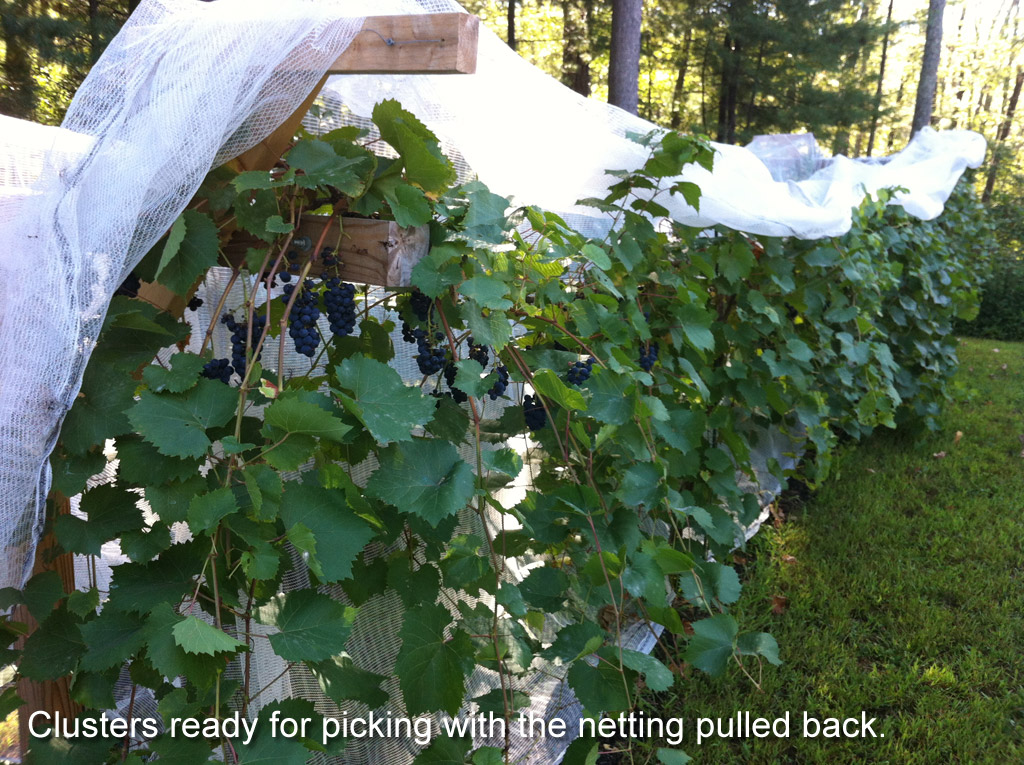
Well, with veraison here and the birds getting excited about a new grape crop to devoir, it was time to test out my new T-shaped trellis wires and put up the bird/bug netting.  A big thanks goes out to my friends Dave and Robyn for lending a big hand rolling out the netting and getting it adjusted just right.  The next day, my kids and a friend of theirs helped me clip 350 (!) clothes pins on the nets to seal up the netting on all sides.  With any luck this will deter both the birds and the yellow jackets.

Now the fruit is ripening within their cocoon of safety.

The T trellis and wires to hold the netting up are working even better than I could have hoped.  The netting is well away from the fruit and the birds have been absolutely baffled by this.  My fingers are crossed....oh please Lord can I get some fruit for winemaking this year PLEASE????

I have noticed that the younger vines on the Cotes d'Oiseau block are lagging at least a week behind the other blocks of vines in veraison.  Hmmm....should be interesting with harvest.  I may have to actually ferment two blocks separately as there is no way I will be able to harvest the entire vineyard at the same time.

Keep your fingers crossed and wish me luck!!!!

-Jacques

A few pictures:


Monday, July 22, 2013

Another step towards netting...

This week I was pretty busy in the vineyard.  After a lot of thinking about last year's disaster with birds and bugs, I came up with a netting plan that is considerably more sophisticated than last year's attempt.  Last year I put bird netting directly over the vines, so it was just laying flat against the shoots.  Unfortunately, with the type of trellis system I have, that puts the nets fairly close to the fruit and the birds quickly figured out they could peck through the netting and reach many of the grapes.  Some would land on the netting and weigh it down, then peck right through to the fruit.  They eat nearly half the crop!  The juicy grapes dripping attracts yellow jackets.  Once the yellow jackets found the vineyard, a swarm came in and drilled holes into the remaining grapes, sucking out the juice.  My entire crop was lost.  Very sad to have nothing to show for a whole summer of work in the vineyard.

I have taken a more systematic approach this year.

1.  I am actively reducing the yellow jacket population with baits/traps.  This started in March.
2.  I am using insect netting this year to attempt to exclude these pests as well as make the bird's lives harder.
3.  I built an extension on the trellis consisting of "T" shaped pieces that suspend two wires above the vines.  I will drape the netting over this apparatus to keep the nets way up above the fruit zone.  No pecking through the netting.  In addition, this can be used like a quasi VSP trellis, to allow some of the shoots that want to up upward to do just that.


As you can see from this shot of the fruit on some of the more mature vines (these are in their 4th leaf) I have a good crop to protect this year!  Crossing fingers I might actually make some wine from my own grapes this year.


There is a small section of the 5th year vines that are already starting veraison (changing color) so I am now in good shape to get the netting on this week when I can drum up another set of hands to help.


So that's about it for now.  I'll make another post when the netting goes on and we can see how this all works.

-Jacques

Saturday, July 13, 2013

It has been a while since my last post.  It didn't seem necessary to post pictures and comments about early spring in the vineyard.  I have done it many times before, so why be redundant?  I was waiting for something interesting and new to say before posting.

So, I'll bring you quickly up to speed on 2013.

During the dormant phase this winter, I did my usual annual pruning (I use a spur prune system on a high wire cordon trellis).  I burn the cuttings and spread the ash on the vineyard to bring the nutrients back to the soil, as I observed in Burgundy in 2011.  This was a wet spring, yet somehow, the fruit set wasn't bad.  Not great, but better than last year.  I have 6 vines in their 5th leaf, quite a few in their 3rd and 4th leaf, and 9 vines in their second leaf.  I could be close to full scale production next year, but this year it will be an interesting and solid harvest if I can finally get some grapes all the way to ripe without some calamity, natural disaster, pests, or some combination of them all!

I'm impressed by the incredible vigor of mature Marquette vines--they can quickly take over a vineyard.  I went to Maine for 6 days with my family and when I returned, shoots had gone all the way across rows into the next row of vines.  Good grief I have no idea how anyone can manage a full vineyard, or even an acre of vines.  It takes an incredible amount of my time just to handle 30 vines!

This spring I started using yellow jacket traps to catch the queens early.  As a result I have seen precious few yellow jackets, thank goodness.  They were my main enemy last year.  I hate those little buggers.  First of all they sting like hell.  And they eat fruit like crazy!  I have also purchased some good insect-exclusion netting that will be put up soon.  Forget bird netting, this keeps out everything. I'm just worried how much sun will get through and if this will be a problem for mildew with reduced air circulation.  I'll have a whole blog post on this netting process, so I won't cover it now.

Once the vines got to the point that the canes were strong enough to be "man handled" a bit, it was time to undertake a little shoot positioning and leaf thinning.  Basically, the vines send the shoots off in any direction that helps them get more sun.  A vine might send a shoot across the row, down the row, and end up 2 vines over.  What a mess you have by mid-July.  Left to their own devices, by fall you wouldn't be able to get through the vineyard without a machete.  So at this phase, I walk down each row and re-position shoots that are going the wrong way.  In general I pull them off the top of other vines and send them down towards the ground.  In a VSP (Vertical shoot positioning) trellis (the kind I wish I had built in hindsight) you would snake them up through the wires towards the sky.  But in a top wire cordon, it's downward they go, then trim them off at ground level.  I had shoots that were over 10 feet long, so that once they were positioned correctly, five feet of cane has to be pruned.  There is no point in letting them snake along the ground--they will spring roots and try to start a new vine.  I kid you not...grape vines are seriously invasive.  Anyone who has wild vines around their house can tell you.  I have some wild vines in my back yard that try to take over the whole place every summer.  No matter how brutal I am yanking them up, chopping them off at the ground, they come right back!

Once the shoots are positioned, it's time for some leaf thinning.  This is hard to get used to, and this is the first year I have done it because it seems so weird.  The idea is to increase light and ventilation in the fruiting zone.  The fruit will mature better and with more flavor if it is exposed to some sun.  So removing the leaves blocking light to the fruit achieves this goal.  In addition, this allows air to move around the fruit better, helping to reduce issues with mildew and hopefully reducing the amount of fungicide that needs to be used.  What's weird is spending years coaxing the vines to become big and healthy, trying to keep bugs from eating the leaves...and then intentionally plucking off leaves.  But by the time the vines are mature and making fruit, they are also making more leaves than they need and spending too much energy on trying to take over the yard.  You need to keep them in check and force them to ripen the fruit, not grow more shoots.

I included a picture of my fake owl standing guard.  Not sure if it helps, but I need all the help I can get from those birds!

I have included a few pictures of the process.  Stand by for netting in a few weeks....

-Jacques


Tuesday, September 18, 2012

Farming is hard!

I don't know exactly what I expected when I decided it was a good idea to plant a vineyard.  But one thing is for certain, I had no idea it would be so hard to get fruit all the way through the process to ripe. Yes, trellising, pruning, watering etc. were learning curves.  Then I had to learn about spray fungicides because our humid New England summers are a black rot paradise.  Then of course I had to learn about pesticides because every bug in the world loves grape leaves and grapes.  Let's not forget the deer which have stripped all the leaves off many a shoot overnight.  Last year I only managed to get literally a bowl-full of fruit to ripeness.  I only had 3 vines mature enough to make grapes last summer.  I assumed I had all my procedures down:  fungicide schedule, insecticide schedule, and bird netting.  This year, with 11 vines making grapes, even with that depressing loss of fruit to hail, I figured I would at least get 50 pounds of grapes so I could make a small batch of wine.

Nope.  I got absolutely zero fruit.  Nada.  Nothing.

What was is this time?  Yellow Jackets!  They are of course those tremendously painful stinging bugs that many people think of as bees.  Not bees.  Bees are good.  Bees pollinate.  Yellow jackets are wasps that eat fruit--and as far as I can tell serve no useful purpose on planet Earth.  Once once they found my grapevines, they built a nest high in a tree out of reach and destroyed my whole crop like a horde of locusts within only a day or so, before I even realized what was happening.  Even though the fruit was sprayed with Sevin (a pesticide) the yellow jackets ignore that stuff.  They are immune to most of the relatively benign pesticides that are not too toxic to people.  So, the entire crop is gone...teaching me a valuable lesson in yet another critter I have to keep from attacking my grapes.

Next year I need a two-pronged approach.  The first is to kill the queens in the spring with Onslaught poison traps before they go and create a zillion workers to eat my grapes.   Next, I am going to experiment with insect netting instead of bird netting to physically exclude the yellow jackets from the fruit.  Also, I will build some T shaped brackets to hold the netting further from the vines as the birds still managed to stand on the netting this year and peck through to any fruit that was within a few inches of the net.

One thing is for sure...grapes have a lot of sugar in them.  (That's why they make good wine).  Animals crave the carbs--it's like candy.  Deer, rabbits, birds and yellow jackets, (God only knows what else) once they find your grapes, are voracious!  It probably doesn't help that I live in the middle of the woods, surrounded by a zillion hungry animals.  But one thing is for sure:  farming is hard.

There is some good news to report however.  My 2011 "Bordeaux Blend" made with Merlot and Cab from Washington state (plus that bowl of estate-grown Marquette) was just bottled.  As the second batch through my new 8 gallon Vadai Hungarian barrel, it has a fair amount of oak that is going to need some time to mellow.  However, it's the first wine of mine that I really think is pretty darned good.  It was awesome before going in the barrel.  Now there is enough oak in there that I'm not sure it's as good, but hopefully the oak will integrate in a couple years and the micro-ox of the barrel treatment will shine through.  We'll see.


-Jacques

Wednesday, August 1, 2012

Damn hail!!!

Many times I have read about hailstorms causing havoc in Bordeaux.  Now I truly feel their pain.  A week ago we got a freak hail storm and it did a number on the garden and vineyard.  It literally shredded leaves on the vines, knocked entire clusters of grapes off the vines, and punctured dozens of grapes on other clusters.  In all, it looks like a loss of at least 10% of my already meagre crop.  :-(  Farming sucks!

Over the weekend we netted the vines since the grapes have started changing color.  Veraison is the term for this metamorphosis, and the result is that it attracts the attention of the birds.  We don't want that!  So time to net and protect the crop I have left!

-Jacques


Tuesday, June 26, 2012

What happens when it rains....

You often hear winemakers lamenting the weather during flowering and complaining about a poor fruit set.  What does that mean?

The tiny flowers of grape vines must be pollinated to create grapes, just like any other fruit.  In the case of grapes, bees certainly assist, but if all goes well, they can pollinate with the wind as long as the flowers stay dry so the pollen can blow freely from one flower to the next.  When the weather gets rainy and the flowers are wet, the pollen won't blow around because it's all soggy.  The bees are not out there working the flowers much in the rain either.  So basically, nothing gets pollinated.

The picture below shows some clusters of Marquette all photographed on the same day.  (Click the pic for a larger view).  On the left, a nice healthy cluster of small grapes that had sunshine during flowering.  In the middle a cluster created by a vine that flowered a couple days later, when it was rainy.  You can see how very few flowers in the cluster got pollinated so the cluster has only a small number of grapes, plus a few tiny grapes that probably will not mature.  On the far right, an extreme example of a cluster that really didn't pollinate well at all.  Fortunately, I only have a few vines that flowered late and ended up with clusters like this.  Who knows why they flowered late, but I'm grateful for the ones that flowered when the sun was out.  This was a rough spring for grapes...very rainy in spite of early warm weather and a mild winter.

That, ladies and gentlemen, is why we pray for sun during flowering!

-Jacques


Tuesday, June 19, 2012

Finally....Grapes!

Here it is the middle of June and my Marquette vines are seriously kicking butt this year.  We had some rain during flowering, which is never good, but I would say that only 1/3 of the vines show clusters significantly affected by the rain.  The result are clusters with vastly different sized grapes on them.  The unaffected clusters all have similarly-sized (and generally larger) grapes.  But the big news is lots of clusters on lots of vines!

There might be more clusters than the vines can ripen.  We'll have to see about that as the summer goes on.  I'm mostly pretty pleased with the growth so far and I am hoping I can get 100 pounds to make a decent batch of wine.

In other news, I drove down to M&M wine today and picked up my Chilean pinot noir, which is a month late compared with last year.  They had a very late harvest and mine was on the last ship.  It actually looked darned good.  I'll get some measurements in the morning on the must once it has had a chance to warm this evening.  I destemmed and crushed it this afternoon, and threw in some Lallzyme to aid with extraction.  I'm going to experiment this time with fewer punchdowns and a cooler ferment to attempt to preserve aromatics and fruit.  Previously, I have been using the Burgundian technique of a single extreme temperature spike to aid in extraction and I really think I'm losing aromatics when I do that.  I'm hoping to replace that action with enzymatically-assisted extraction instead.

My 2011 fall "Bordeaux" (which I'm calling Meritage to be politically correct) is in my barrel and tasting pretty good.  It has a Syrah-like spice/pepper twang to it that is really cool.  I will likely bottle it in the fall when this Chilean pinot noir is ready to be barreled.  If you are really nice, you might get a bottle for Christmas.


-Jacques

Monday, April 23, 2012

2012 is THE YEAR for Chateau Oiseau!

As anyone in the northeast USA knows, spring came early this year.  We had weather in the 80° F range in March!  All the vines went nuts, trying to push out buds.  After a week of unseasonably warm and dry weather, temperatures went back down to normal (in the 40s and 50s) and the vines went into a kind of suspended animation where nothing happened for a few weeks.  Then another couple weeks of unseasonably warm weather happened again in early April.  We actually hit 91° F for a day!  With very little rain, our local pond's water level was at least a foot low and I decided to put some light irrigation on the vines.  As I sit writing this, we have had a solid day of rain from a passing "Nor'easter" that promises a very wet week ahead.  We need the rain, but the timing isn't good, as the vines are leafed out and starting to produce flower clusters.  Hopefully the flowers won't actually bloom for another week.

I have posted a picture of the buds on one of my Marquette vines popping out in only 4 days.  It's really amazing to watch.  If you compare the dates between this year and last, everything is a full 2 weeks early.  Spring is a busy time in the vineyard.  I have spent the last few weeks removing buds and shoots from the trunks of the vines, spraying fungicide (very important to hit the vines in the spring with fungicide to control black rot), adding composted manure to the vineyard, and hoeing the weeds between the vines.  I'm trying to reduce my use of chemicals like Round-up in the vineyard.  Of course, going "organic" is largely impossible in the northeast as our humid weather simply breeds too much mold and mildew that needs controlling, and the insects will eat everything without some chemical interference.  So hoeing the weeds is one small thing I can do rather than depend on Round-up.

The good news is that I have 6 vines going into their 4th summer, and another 10 or so going into their 3rd summer.  These vines all have tiny flower clusters forming and most are going to make grapes this summer!  So with a little cooperation from Mother Nature and some gentle nurturing from me, I might actually make a batch of Marquette wine this year!  This is exciting!  Four years of hard work and expense and I can finally make wine from my own estate grown grapes!

In the cellar, not much is happening.  I bought an 8 gallon Vadai Hungarian Oak (same wood species as "French oak" but not made in France, hence cheaper) barrel in February and my 2011 spring Chilean Merlot is in there now.  Small new barrels are famous for over-oaking the wine as they have a lot of surface area as a function of volume.  Even though I put water in the barrel for a couple weeks to seal it up and extract some of the oakiness, I'm pretty sure the first batch of wine in there is over-oaked pretty significantly.  On the flip side, this Merlot wasn't that great and maybe a little too much oak is just what it needs to cover its flaws!  ;-)  Once I bottle it (next month) I'll wash out the barrel and put my 2011 fall "Bordeaux Blend" in there.  I don't want to brag, but this wine is actually good.  Very good.  With a little time in a barrel I think it might be awesome and the first wine I have made that I'm proud of.  And just in time, because I have that Marquette to turn into wine this fall I hope!


-Jacques

Saturday, October 22, 2011

The Fall 2011 Winemaking begins!


Well, the summer seemed to fly by and I haven't posted an update here since the end of June. So what has happened?

Well, around the beginning of August we had veraison in the Marquette, the time when the grapes start changing color. Grapes do this to signal the birds that they are ready to eat. That way the birds will spread their seeds around. Of course we don't want the birds to eat the crop, so we have to put bird netting on the vines. What a pain that is (but nothing compared to getting them back off again!)

Due to my travel schedule, I had to harvest the Marquette a little earlier than anticipated at around 22 brix because I had a trip to the Maldives and I was afraid they would hang too long otherwise. In addition to the rain during flowering which made for some bad fruit set and small, loose clusters, we also had a solid week of rain in late August that caused a lot of grapes to split. Overall, 2011 was a terrible year for growing grapes in Massachusetts. At least for me. Fortunately, I only had a few vines making fruit and there was no way I was going to get enough for a batch of wine anyway. So this is just an experiment year.

My Reliance (seedless) vines made a ton of grapes, and then right before they were ready to harvest, they all fell off the vine. Some had bee damage, but most just literally fell on the ground and got eaten. The vines were well netted. I have no idea what happened, but it has shaken my belief in Reliance. I have decided to remove the whole row of them in the spring and replace with Marquette. Reliance is not for making wine and I have no idea what to do with 40 pounds of Reliance if we ever get a harvest.

By the time Marquette harvest came (Sept 15th) I was down to about 2 pounds of actual harvestable grapes. But it was still a thrill to make my very first (tiny!) harvest. I froze the grapes to be added to my next wine batch. (More on this...keep reading)

Because I was going to be in the Maldives during the time when the California grapes would arrive for us east coast winemakers, I made the decision to order Washington state grapes for my fall winemaking. They wouldn't come until October, and I would be back from the Maldives. Since Washington Pinot Noir is not an option from my local retailer, I ordered Merlot and Cabernet Sauvignon to make a "Bordeaux blend." I find it odd that we can get Cab from Washington but not Pinot noir. It seems to me that it must be hard to ripen Cab that far north, but that is a great climate for Pinot Noir.

The grapes arrived yesterday so I had to drop everything and go into wine making mode (something I enjoy!) As usual, I manually de-stemmed all the grapes. My daughter helped for about 10 minutes then got bored and left. My fingers were sore (and purple) all night afterwards. I really need a destemmer. For the most part the Cab looked as Cab should--tight clusters that are hard to de-stem, with dark blue berries. But when I crushed them, the seeds were still green--a sure sign that they are not ripe. My refractometer (see pic here) indicated between 22 and 23 brix on all the berries I tested, which is to say definitely not ripe. I can only imagine the pH. Fortunately, I'm doing a co-ferment blend with the Merlot and those berries had nice brown seeds and tested out at 26-27 brix (nice and ripe) so with any luck, they will cancel each other out and end up good. I also tossed my 2 pounds of frozen Marquette in there. So my wine will be 1.3% Estate Grown! LOL!

After destemming and crushing, the pH was 3.25. Egads, that's low! A small treatment with Potassium bicarbonate brought the pH up to 3.4 which is a lot better. In addition to a tiny dose of meta to kill bacteria, I added Lallzyme EX, my first attempt with an enzyme. The point is to try getting more color and tannin out of the skins. My previous attempts with really dark grapes (Merlot, Malbec) ended up looking more like pinot noir. On this batch I'm using several different techniques to get some extraction: an enzyme, a peak ferment temp into the 90s for a day and some tannin added before ferment to bind color and hopefully deal with the expected "vegetal" character of the unripe Cab.

This morning after the must had sat at 60 degrees all night, I couldn't believe the extraction of color I already had just from the enzyme! This is encouraging! Next I added the tannin and some Opti-red (again, to help with color) and started my yeast hydration. I have been using Go-Ferm for yeast hydration and Fermaid-K for nutrients along the ferment and that seems to work great. Now I have inoculated the must and I'm waiting for the ferment to start (at low temp) before bringing in the heat. This helps the yeast to get going before any bacteria can because the yeast will get going (slowly of course) at low temp much better than bacteria. Applying heat to the must before the yeast is in there is an invitation to bacterial growth.

Once the must had been inoculated, it was time to bottle my Fall 2010 California Pinot noir in order to clear out a carboy. This is the third wine I have bottled. Tasting notes? Well, it's flawed but not as badly as the previous two. I consider it drinkable, which is more than I can say for the spring 2010 wines. However, I still detect that "home winemaking aroma" that I detect in a lot of home-made wines, not just mine. I think it's the slight leftover taint from hydrogen sulfide. As well, the wine is pretty thin and lacks character. You can drink it, it tastes like wine, and a person who hasn't got much palate for wine (you know who you are Tim) would think it's fine. But it's flawed. I certainly won't be entering it in any wine competitions.

So anyway, I disinfected a bunch of bottles, put them on the bottle tree to dry, and started filling and corking. I ended up with 34 bottles. I'll label them and put on the heat-shrink capsules tomorrow. More wine in the cellar that I seriously doubt will improve with age!

Next I racked the spring 2011 Merlot. This is 6 months old and was ready for a racking plus the addition of some oak spirals. Christine and I tasted it and here's what I can say. It has no noticeable flaws! Which is a first for me. And it tastes okay. But for Merlot, it's pale and lacking tannin and body. If I handed a glass to a wine lover and asked that person to identify it, any sane person would conclude that it is pinot noir. It's not dark and "thick" like Merlot should be. For some reason, no matter what grape I start with, I keep making "pinot!" Hence you can see that I have a problem with getting good extraction. Keeping my fingers crossed on the extracting of this new Bordeaux blend! I'll keep you posted, and thanks for reading!

-Jacques